
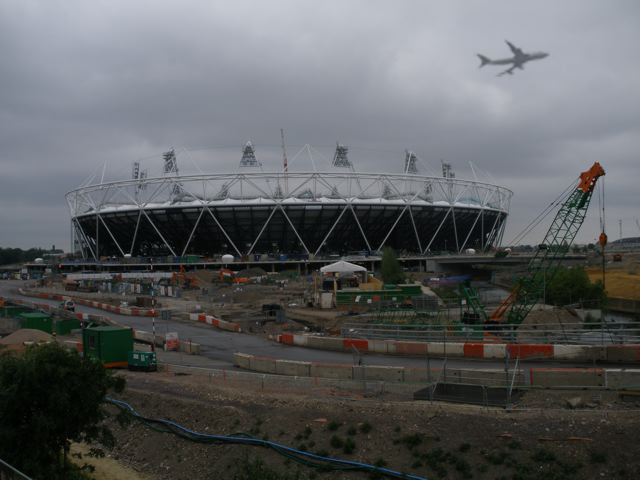
Plans to reveal yet another statue.

Jan 31 2012 Published by under Olympics 2012

The Camden New Journal yesterday uncovered plans to erect a statue of Christ the Redeemer on Primrose Hill. The statue will be a tribute to the one overlooking Rio de Janeiro, to celebrate passing on the torch (pun begrudgingly intended) to Brazil for 2016.

The Brazilian government would fund the project, and a planning consultancy based in London has been employed by Brazil’s tourist agency to hold a public meeting to display the designs before applications for planning permission are submitted.

The Camden-based design company See Me, Hear Me, Feel Me did not want to discuss the plans, and the Brazilian government was unavailable for comment, but Primrose Hill Lib Dem councillor Chris Naylor said he wasn’t sure a 30ft statue of Christ with his arms outstretched was quite what the area needed.

Other statues to celebrate the Olympics have been erected around Britain, often to the displeasure of residents. The ‘Jurassic Stones’ statue, by Richard Harris, has been greeted with horror by residents of Weymouth, Dorset. The Stones’ £335,000 bill pales in comparison to the £19m spent on Anish Kapoor’s ‘ArcelorMittal Orbit’, on site in Stratford.


Many people question why so much money is being spent on statues to celebrate the Olympics, and whether it is appropriate in the current economic climate. The term ‘Legacy’ has always been used to describe the impact of mega-events like the Games: urban development, social, economic and cultural changes are words often thrown around in relation to the Legacy. However, the term has been re-appropriated by critics of the Games and become somewhat of a joke. The Legacy that does seem to be taking shape is symbolised in the statues cropping up around the country – abstracted, distorted, and expensive.

The real Olympic Legacy will be towering debt.

For other Olympic links and Spectacle’s video archive

For more London Olympics Blogs
See our Olympics project pages for more information and videos.
Or visit PlanA our general blog on urbanism, planning and architecture.

Spectacle homepage
Facebook Spectacle.Docs
Follow SpectacleMedia on Twitter

Share and Enjoy:
  • Print
  • Digg
  • StumbleUpon
  • del.icio.us
  • Facebook
  • Yahoo! Buzz
  • Twitter
  • Google Bookmarks
  • Add to favorites
  • Current
  • email
  • Google Buzz
  • Identi.ca

No responses yet

Chief of 2012 Ethics Panel Resigns

Jan 27 2012 Published by under Olympics 2012

Meredith Alexander, Chief of LOCOG’s ethics panel, has resigned over the continuing sponsorship of the games by Dow Chemicals. Dow Chemicals currently owns Union carbide, who were responsible for the mishandling of poisonous gas tanks, which caused the deaths of thousands of people in 1984. Dow’s  sponsorship of the games has been heavily criticised, and Alexander’s resignation only highlights another of the ethical swamps through which LOCOG is determinedly wading for funding.


Click London Olympics for more blogs
See our Olympics project pages for more information and videos.
Or visit PlanA our general blog on urbanism, planning and architecture.


Spectacle homepage
Befriend Spectacle.Docs on Facebook
Follow SpectacleMedia on Twitter
Share and Enjoy:
  • Print
  • Digg
  • StumbleUpon
  • del.icio.us
  • Facebook
  • Yahoo! Buzz
  • Twitter
  • Google Bookmarks
  • Add to favorites
  • Current
  • email
  • Google Buzz
  • Identi.ca

No responses yet

Whose Common is it, really?

Jan 27 2012 Published by under Olympics 2012

The Olympic Delivery Authority/London Organising Committee of the Olympic and Paralympic Games (ODA/LOCOG) expected Greenwich Council to grant planning permission for Circus Field to be used for the purposes of the Olympics, even though no details of the proposed use have been included in the public consultation documents.

To this end, LOCOG wanted to be able to enclose parts of the grounds for the equestrian events there. However, for this they needed permission from a Regional Development Authority. This little legal mechanism is to avoid national authorities from riding roughshod over smaller, regional areas.

To get around such sticky planning issues, the London Olympic Games and Paralympic Games Act 2006, was drafted to include, among the purposes of a Regional Development Authority (s.36(1)), the task of preparing for the Olympic Games. However, by virtue of s.36(2), the may only prepare directly “at the request of the Olympic Delivery Authority.” Therefore the responsibility of the Regional Development Authority (specifically now the London Development Agency) is acting at the request of the ODA, in this instance, in acquiring a short lease of Circus Field from the Crown Estates owner of this part of the registered common. Part of the Olympics Act (Section 36 paragraph 3(c)) also stated that “no enactment regulating the use of commons, open spaces or allotments shall prevent or restrict the use of the land for construction, other works or any other purpose (but this paragraph does not disapply a requirement for planning permission)”.

All of this means is that the ODA can directly order the Regional Development Authority to apply for permission to build on whatever common they so desire.

However, as Mrs. Mawhood, who works independently and on behalf of NOGOE 2012, has pointed out, Circus Field is not a “registered common”, it is Metropolitan Common Land. This places it in the remit of the Metropolitan Commons Supplemental Act 1871, which creates its own restrictions: “The Commissioners shall not entertain an application for the enclosure of a metropolitan common, or any part thereof” (Section 5) This does suggest that a separate act of parliament is required to enclose a Metropolitan Common…

Nothing will stop LOCOG though! They have have now signed a tenancy of 12 months granted by the Crown Estate to the ODA by virtue of new legislation. This agreement overrides the need for any permission (apart from planning) from Greenwich.

This only lends yet more credibility to the accusation that the Olympics is not a project which listens to opposition, especially on planning grounds, where the rules are simply rewritten to suit the project’s needs.


Click London Olympics for more blogs
See our Olympics project pages for more information and videos.
Or visit PlanA our general blog on urbanism, planning and architecture.


Spectacle homepage
Befriend Spectacle.Docs on Facebook
Follow SpectacleMedia on Twitter

Share and Enjoy:
  • Print
  • Digg
  • StumbleUpon
  • del.icio.us
  • Facebook
  • Yahoo! Buzz
  • Twitter
  • Google Bookmarks
  • Add to favorites
  • Current
  • email
  • Google Buzz
  • Identi.ca

No responses yet

Olympic Equestrian Event Debacle Continues

Jan 24 2012 Published by under Olympics 2012

No tree will be cut down…

Preparations for the controversial equestrian events to be held in Greenwich Park are still underway, despite ever mounting pressure from groups and individuals protesting the decision. Among the numerous concerns over damage to the park, which is a world heritage site, there are fears of gridlock across the city, abuses of planning permission by LOCOG (London Organising Committee of the Olympic and Paralympic Games), and most worryingly of all, the safety of the public.

The planning application, published 8th Dec 2009, shows that the rare acid grassland will not be fully restored and reopened until “November 2015″, during which time a great deal of permanent damage will have been done to the park. Greenwich Park is a Conservation Area, every one of the approximately 3,000 trees  in the Park has a Tree Preservation Order on it, but despite this and assurances that “no tree will be cut down”, extensive ‘pruning’ has been underway. Several fragile trees have had major limbs amputated for the end of better camera sight-lines; injury from which some will not recover.

Although Greenwich Royal Park is the FEI’s (Fédération Equestre Internationale) preferred venue for the 2012 equestrian events, LOCOG has not made the smallest attempt to comply with the FEI Code of Conduct towards the Environment. The FEI’s code states that the protection of the environment must always prevail over the technical requirements of the various disciplines when organising events and in particular in the following cases:
a) Harmonious integration: Equestrian facilities should be built or converted
so as to ensure their harmonious integration into the local context,
whether natural or man-made, and in accordance with considerate
planning of land use.
b) Preservation of countryside: Equestrian events such as Driving, Endurance
and Eventing (cross country phase) must be so arranged as to ensure the
protection of conservation areas, the countryside, the cultural heritage and
natural resources as a whole.

Clearly, LOCOG’s systematic mutilation of the park does not fall within these guidelines.

The London Olympic Games and Paralympic Games Act 2006 (Section 5 (4a)) contains a clause in it’s Planning section that allows the Olympic Delivery Authority to disregard a section of the Town and Country Planning Act 1990 (Part III, Section 74, (1b)). This section pertains to the manner in which a local authority regulates planning permission applications, particularly  “for authorising the local planning authority to grant planning permission for development which does not accord with the provisions of the development plan”. The local planning authority has just stood idly by while LOCOG hacks up the park, without uttering a squeak of protest.

However, the LOCOG steamroller does not stop there. The Games organisers have implemented regulations “intended to meet commitments by the UK Government to the International Olympics Committee. The main aims are:
-to ensure all Olympic and Paralympic events have a consistent celebratory look and feel to them,
-to prevent ambush marketing within the vicinity of the venues; and
-to ensure people can easily access the venues.
To achieve these aims, “Interferences with the rights to freedom of expression and protection of one’s possessions may be justified on related grounds” (Paragraph 7, Human Right Assessment, The London Olympic Games and Paralympic Games (Advertising and Trading) (England) Regulations 2011 Impact Assessment). These interferences include “An interference with the right to be presumed innocent will be justified where it is confined “within reasonable limits which take into account the importance of what it at stake and maintain the rights of the defence” (Paragraph 24). Or, putting it another way, if anyone is caught interfering with the ‘consistent celebratory look and feel’ of the event, they can be presumed not to be innocent and, no doubt, removed.

The most worrying aspect of LOCOG’s irresponsibility where Greenwich Park is concerned relates to the safety of the public. The Royal Parks’ own “Guidelines for Event Organisers 2010″ state that the capacity of the park provides for up to 15,000 and *possibly* more for “certain events”. This is nothing like the 50,000 (the number of cross-country day tickets that LOCOG say they have already sold). In the past, for example at the beginning of the London Marathon, there have been up to 21,000 runners in the park for a few hours at a time, and this with 9-10 exits available. However, the Olympic equestrian events will continue all day for several days and the area will be surrounded by fences, potentially with electrified tops. There are only three planned exits from the event zone. How difficult will it be to evacuate 50,000 people through 3 exits in 2-8 minutes? How difficult will it be to do this safely?

It is not difficult, however, to see how easily this could all descend into chaos. Even despite the risk of terrorism during the Olympic Games this summer, such irresponsible cramming of people into an undersized venue poses huge risks to the safety of those hoping to attend the events.

Clearly, LOCOG’s priority is once again with their sales, not with their responsibilities to the Park, the quality of the games, the public….


Click London Olympics for more blogs
See our Olympics project pages for more information and videos.
Or visit PlanA our general blog on urbanism, planning and architecture.


Spectacle homepage
Befriend Spectacle.Docs on Facebook
Follow SpectacleMedia on Twitter
 

Share and Enjoy:
  • Print
  • Digg
  • StumbleUpon
  • del.icio.us
  • Facebook
  • Yahoo! Buzz
  • Twitter
  • Google Bookmarks
  • Add to favorites
  • Current
  • email
  • Google Buzz
  • Identi.ca

No responses yet

Olympic Mascot Toys Allegedly Made In Sweatshops

Jan 24 2012 Published by under Olympics 2012


New allegations have been made that cuddly toy versions of the Olympic mascots are being produced in factories that abuse worker’s rights. The allegations have led to an internal investigation by LOCOG. The British toy company Golden Bear, who sell the mascot toys have been accused that  workers in their Chinese factory are alleged to work more than 11 hours a day, for 26p per hour. Golden Bear, along with the BTHA (British Toy and Hobby Association) have launched an inquiry and LOCOG claims to have contacted licensees to ‘reiterate the importance we place on the sustainable sourcing code they have each signed up to.’ A LOCOG spokesperson has said that they ‘place a high priority on environmental, social and ethical issues when securing goods and services and take these allegations extremely seriously’.

The LOCOG Sustainability Source Code (http://www.london2012.com/publications/locog-sustainable-sourcing-code.php) outlines LOCOG’s approach to the sustainable sourcing of materials, from timber for furniture and fitting to the product specific industry standards in merchandising. The principal audiences of the Code are internal buyers and specifiers and prospective suppliers and licensees i.e. both the LOCOG merchandising team and the toy’s manufacturers, Golden Bear. The code specifies that:

“Put simply, our approach to sourcing sustainable products can be based
on the following five key questions:
1. Where does it come from?
2. Who made it?
3. What is it made of?
4. What is it wrapped in?
5. What will happen to it after the Games? ”

It’s aim is that interested parties “can better understand our views on sustainability and how they are being implemented.” Prospective suppliers and licensees are advised to review the requirements of the Code and ensure that relevant areas of their business and supply chain are in compliance with its provisions. On occasions when we are sourcing services which involve labour, LOCOG uses the Ethical Trading Initiative (ETI) Base Code (http://www.ethicaltrade.org/resources/key-eti-resources/eti-base-code) as the required standard that suppliers should be achieving. in the case of Golden Bear’s factory, LOCOG’s processes for the tendering of contracts, both the Sustainability Source Code and the ETI Base code, seem to have been neglected. The question therefore is, how has this happened?

The LOCOG Code states that “following our due diligence process and award of a contract, we will monitor a supplier or licensee’s practices to ensure they are being carried out as agreed in the tender process”, and they utilize a spend priority categorization system to determine the likelihood of assessment and monitoring during the tender process. This means that the higher the priority according to the spend categorization the more likely it is that the prospective suppliers and licensees will be evaluated for their ethical sustainability. According to LOCOG sustainable sourcing code, the product specific industry standards for merchandising (the category into which the toy mascots fall) are rated as “moderate” priority and are SEDEX (Supplier Ethical Data Exchange – http://www.sedexglobal.com) mandated, though no guidelines or strategies exist for supporting sustainability. The upshot of this is that the potential for merchandise suppliers to be assessed during the tender process “will be determined by LOCOG on a case-by-case basis”, with “moderate” priority for sustainability support.

Perhaps in the case of Golden Bear the assessments were not deemed necessary. Perhaps the difference between “moderate” and “high” priority is purely a result of interest in the abuses of factory workers. Perhaps it is even the case that the LOCOG Sustainability Source Code is an elaborate exercise in demonstrating how important such ethical issues are in relation to the spending of money. It does seem more likely, though, that their prerogative is, as stipulated on page three of the Code, that “LOCOG will do business with suppliers and licensees who are best placed to deliver outstanding value for money”. In the case of the Golden Bear factory, this seems to be at odds with their commitment to sustainability as “one of several core elements which make up how we (LOCOG) define value for money.”


Click London Olympics for more blogs
See our Olympics project pages for more information and videos.
Or visit PlanA our general blog on urbanism, planning and architecture.

Spectacle homepage
Befriend Spectacle.Docs on Facebook
Follow SpectacleMedia on Twitter
Share and Enjoy:
  • Print
  • Digg
  • StumbleUpon
  • del.icio.us
  • Facebook
  • Yahoo! Buzz
  • Twitter
  • Google Bookmarks
  • Add to favorites
  • Current
  • email
  • Google Buzz
  • Identi.ca

No responses yet

Havelange leaves IOC just days before hearing

Dec 06 2011 Published by under Olympics 2012

Joao Havelange has resigned from the International Olympic Committee (IOC) just days before an ethics commission was due to deliver their findings on allegations he received bribes when FIFA president.

With his resignation the investigation is likely to be dropped on the  grounds that the committee no longer have jurisdiction over him.

Fifa also confirmed Havelange’s resignation adding: “Fifa has taken note of Joao Havelange’s resignation as IOC member and the fact that the IOC has closed the case accordingly.”

The 95-year-old  was the IOC’s longest-serving member having joined in 1963. He served as Fifa president between 1974 and 1978, before he was replaced by Sepp Blatter.

Two other IOC members, International Association of Athletics Federations president Lamine Diack and Issa Hayatou, president of the Confederation of African Football, will have their cases considered by the committee on Thursday.

Share and Enjoy:
  • Print
  • Digg
  • StumbleUpon
  • del.icio.us
  • Facebook
  • Yahoo! Buzz
  • Twitter
  • Google Bookmarks
  • Add to favorites
  • Current
  • email
  • Google Buzz
  • Identi.ca

No responses yet

How to sponsor the Olympics in 4 easy steps…

Sep 23 2011 Published by under Olympics 2012

Calling all Olympic 2012 sponsors!

Did you know that London can have that glossy just-out-of-the-showroom clean city look in four easy steps?

Consumers Spectators will get the chance to experience that special Olympic “feeling” by seeing your products on billboards all the way to each sporting venue. Not only that, with careful planning you will be guaranteed (yes, guaranteed!) maximum exposure in all other parts of the capital.

Here’s all you need to do:

1. Seek out people wearing clothes advertising rival products and either get them to wear them inside out or use masking tape to cover up the offending image so they’re not spotted on TV.

2. Rename well-known buildings  if they are sponsored by a rival brand (think O2 Arena.)

3. Book up as much billboard space as possible in and around the capital so your competitors can’t get a look-in.

4. Remove all of your rivals drinks and food from all “Olympic family” establishments so only your products can be consumed.

Simples!

To find out more click here.


Click London Olympics for more blogs.
See our Olympics project pages for more information and videos.
Or visit PlanA our general blog on urbanism, planning and architecture.

Spectacle homepage
Befriend Spectacle.Docs on Facebook
Follow SpectacleMedia on Twitter
Share and Enjoy:
  • Print
  • Digg
  • StumbleUpon
  • del.icio.us
  • Facebook
  • Yahoo! Buzz
  • Twitter
  • Google Bookmarks
  • Add to favorites
  • Current
  • email
  • Google Buzz
  • Identi.ca

No responses yet

Olympic legacy – a potential disaster?

Sep 21 2011 Published by under Olympics 2012

Richard Caborn, the sports minister at the time London won the Olympic bid, will speak today raising his concerns over the potential failure of the Olympics’ sporting legacy.

In his keynote speech at the annual meeting of the Sports and Recreation Trust Association in Birmingham, Caborn will elaborate on his comments, quoted in the Guardian today, that there was a “danger of failing completely,” adding that there needed to be a “major change of direction in the strategy on this if the disastrous decline experienced by many of the sports is to be reversed.”

The latest quarterly figures from Sport England show that the target to increase the number of people playing sport three or more time a week by one million by 2013 is a long way off the mark with a more modest increase of just under 110 thousand from 2007-08.

Click here for the full article

Click London Olympics for more blogs
See our Olympics project pages for more information and videos.
Or visit PlanA our general blog on urbanism, planning and architecture.

Spectacle homepage
Befriend Spectacle.Docs on Facebook
Follow SpectacleMedia on Twitter

Share and Enjoy:
  • Print
  • Digg
  • StumbleUpon
  • del.icio.us
  • Facebook
  • Yahoo! Buzz
  • Twitter
  • Google Bookmarks
  • Add to favorites
  • Current
  • email
  • Google Buzz
  • Identi.ca

No responses yet

New Olympic legacy website: London-Rio: Olympic Cities

Jun 24 2011 Published by under Olympics 2012

Mega Event Cities

London-Rio: Olympic Cities

“Cities across the globe are using mega events to catalyse urban development and social, economic and cultural change. Here we present insights and analysis of these events, examining their impact upon city-building and exploring their contribution to the design and shaping of place.

Our research is policy focused and practical. Our approach is focused upon the social impacts and legacies of mega events. We use interdisciplinary analysis to discover new ways of comparing and thinking about the mega event city.

We are interested in receiving comments on the site and suggestions for relevant material or links to be placed on it. The site will be dedicated primarily to housing academic work on the social legacies of mega events, particularly those referring to London 2012 or Rio 2016. We would also welcome links to our site being placed in sites addressing similar themes.”

For other Olympic links and Spectacle’s video archive

For more London Olympics Blogs
See our Olympics project pages for more information and videos.
Or visit PlanA our general blog on urbanism, planning and architecture.

Spectacle homepage
Facebook Spectacle.Docs
Follow SpectacleMedia on Twitter

Share and Enjoy:
  • Print
  • Digg
  • StumbleUpon
  • del.icio.us
  • Facebook
  • Yahoo! Buzz
  • Twitter
  • Google Bookmarks
  • Add to favorites
  • Current
  • email
  • Google Buzz
  • Identi.ca

No responses yet

Spurs and Leyton Orient to launch review over Olympic Stadium

Apr 15 2011 Published by under Olympics 2012


Tottenham Hotspur and Leyton Orient are applying to the high court for a review of the OPLC’s (Olympic Park Legacy Company) decision to award West Ham United the chance to move into the Olympic stadium after the 2012 Olympic games.  One of the reasons for OPLC’s decison to pick West Ham was that they had said in their bid for the stadium, that they would keep the athletics track, whilst Spurs had argued the only viable option was to rebuild the entire stadium as a dedicated football ground.

Leyton Orient’s chairman said. ‘We will shortly apply to the High Court for judicial review and take action against the Premier League for ignoring their own rules.’

A big concern for Leyton Orient is that because of the size of the stadium, West Ham plans to offer discounted tickets. The worry is that this could significantly effect Orients ability to generate ticket revenue since the clubs current home is the Matchroom Stadium just over 2 miles from Stratford. The club’s fan groups have launched an online petition urging the Government to revoke the decision. Orient have also accused Newham council of granting “unlawful state aid” to West Ham in offering them a £40m to finance their move into the Olympic stadium after the games.

What are they doing lending £40m to a football club? They are not allowed to be involved in commercial deals. This is state subsidy of a commercial operation, which falls foul of European competition laws.‘ Barry Hearn (Orients chairman) said. ‘We are asking them to withdraw it. It is state aid and they don’t have the authority to make this kind of commercial investment under their charter.’

This another incident linked to the Olympics where there is no accountability.  It seems that although the decision to award West Ham the loan is technically illegal, it is allowed to happen because of its connection to the Olympic games. Should allowances such as this be made just because of its links to a major event ? It seems unlikely that West Ham will be able to pay back such a huge loan given football isn’t renowned for financial sustainability and it will be the Newham taxpayers who will be liable for the debt in the event of default.

In January, BBC London found a number of potential ‘abuses’  during the process leading up to the loan. These included:

  • Crucial documents explaining the bid in detail being withheld from councillors until shortly before the vote
  • No explanation as to whether the council would be liable for the debt if relegation-threatened West Ham defaulted
  • A ‘significant number’ of councillors holding reservations – but refusing to speak openly because they are allegedly “afraid” of missing out on lucrative positions
  • Mayor of Newham Sir Robin Wales declaring dozens of gifts from West Ham, with critics saying his impartiality has been compromised

For more information click BBC News

Spurs also intend to take the OPLC to court over a number of concerns they have about the process which led to the decision to give West Ham the £537 million stadium. They released a statement saying that,

‘Our lawyers have written to the OPLC, the Mayor of London, the Minister of Sport and the Secretary of State for Local Government and a separate letter to the London Borough of Newham raising a number of concerns with the processes which led to the award.’

‘The letters also requested – in the interests of transparency – for the provision of certain information concerning the processes, which the Club considers that it is entitled to. Tottenham Hotspur will determine its next step as and when it receives a response to these letters.’

Tottenham also plan to challenge the £40m loan which West Ham will be given at preferential rates that was not been offered to any other bidders for the stadium believed that this will form a key argument  for Spurs’ claims against the decision.

Tottenham said that they have now ‘sought permission from the High Court to bring a claim against the London Borough of Newham (“Newham”) for judicial review of Newham’s process in providing a loan for the conversion of the Olympic Stadium after the 2012 Games.’

A spokesperson from the OPLC stated that, ‘We have been consistent, fair, objective and entirely equal in our dealings with the bidders from start to finish. We are confident that if these judicial review proceedings are pursued, our approach will be entirely vindicated by the courts.’

Click London Olympics for more blogs

See our Olympics project pages for more information and videos.

Or visit PlanA our general blog on urbanism, planning and architecture.

Spectacle homepage

Befriend Spectacle.Docs on Facebook

Follow SpectacleMedia on Twitter

Share and Enjoy:
  • Print
  • Digg
  • StumbleUpon
  • del.icio.us
  • Facebook
  • Yahoo! Buzz
  • Twitter
  • Google Bookmarks
  • Add to favorites
  • Current
  • email
  • Google Buzz
  • Identi.ca

No responses yet

Older posts »