The Regeneration Game

DSC_0133

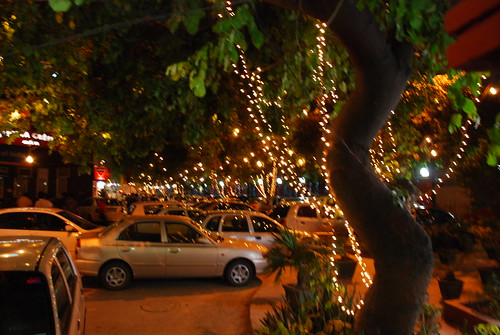
Khan Market , New Delhi

The signs of regeneration are all over Delhi. Billboards proclaim ‘DELHICIOUSLY YOURS’ throughout the city, and  it is. The pace of work completed between June and now are staggering – the air-conditioned metro, Delhi’s prize feature, works efficiently; lights decorate various hubs of tourist activity and promote a warm, festive atmosphere; and customs takes only ten minutes to get through, as opposed the the previous hour. These are the positive aspects of regeneration and they indicate how far India can go and how much could have been achieved minus the corruption scandals and the delays.

Walk a few metres away from all of this, however, and you are confronted again with real Delhi – unpaved streets, buildings fallen into disrepair and open sewers perfuming the air. There is no sign, however, of the customary wallahs – the newspapers are full of tales of people returning to collect suits from streetside tailors only to find they have been moved on; cigarette wallahs, barbers, fruit-sellers, as well as beggars and the homeless – all have mysteriously disappeared without trace or concern.

According to some Delhi residents affected by the migration, their maids and their families were simply told to ‘leave Delhi for twenty days’ – the duration of the Games and the days preceding and following. Those who did not comply willingly were forced; shacks burned up in inexplicable circumstances and not all dwellers were recompensed. It is an open secret in Delhi that many of the poor were herded to a large slum outside the city, but it has been made extremely difficult for activists and media workers to photograph or document it, and those living there who have tried to fight back have been effectively dissuaded.

Regeneration is a game, of course, even if its prizes do not glide by neatly on a conveyor belt, and so it follows that not everybody wins.

Click London Olympics for more blogs
See our Olympics project pages for more information and videos.
Or visit PlanA our general blog on urbanism, planning and architecture.

Spectacle homepage
Befriend Spectacle.Docs on Facebook
Follow SpectacleMedia on Twitter
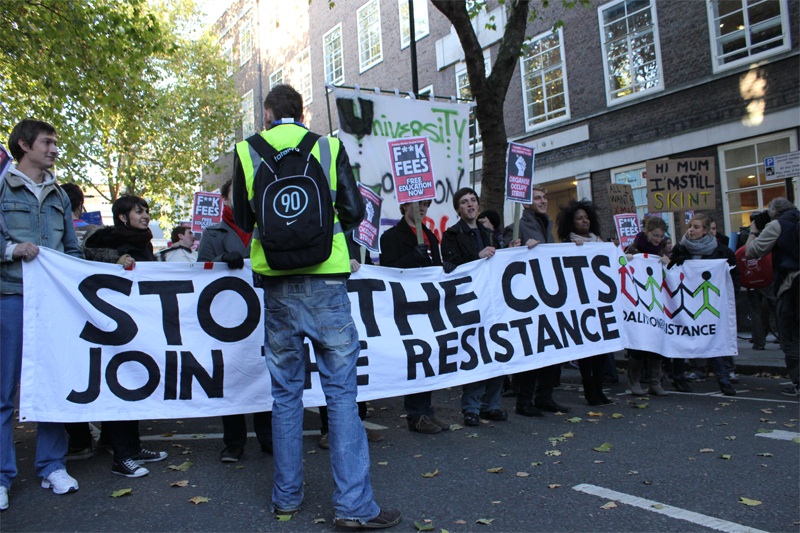
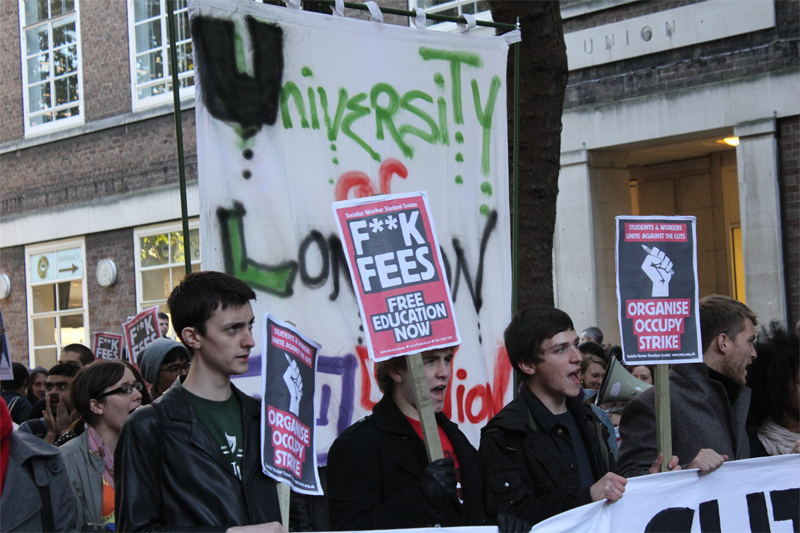
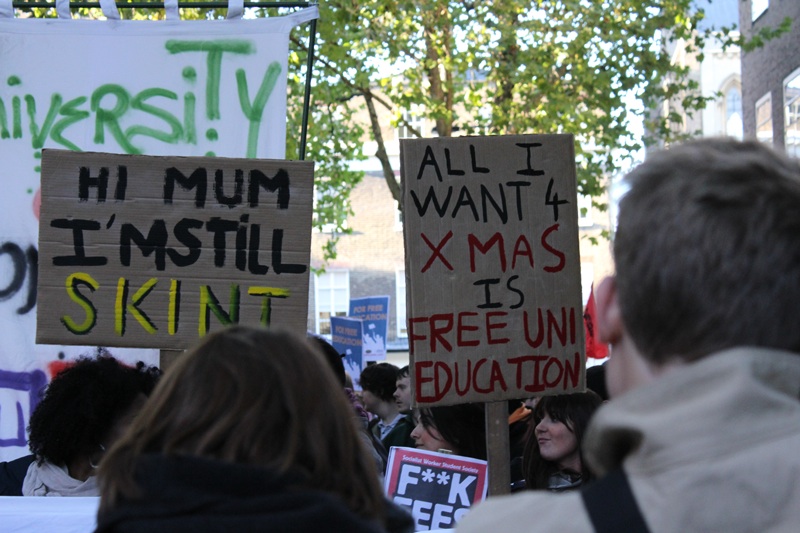
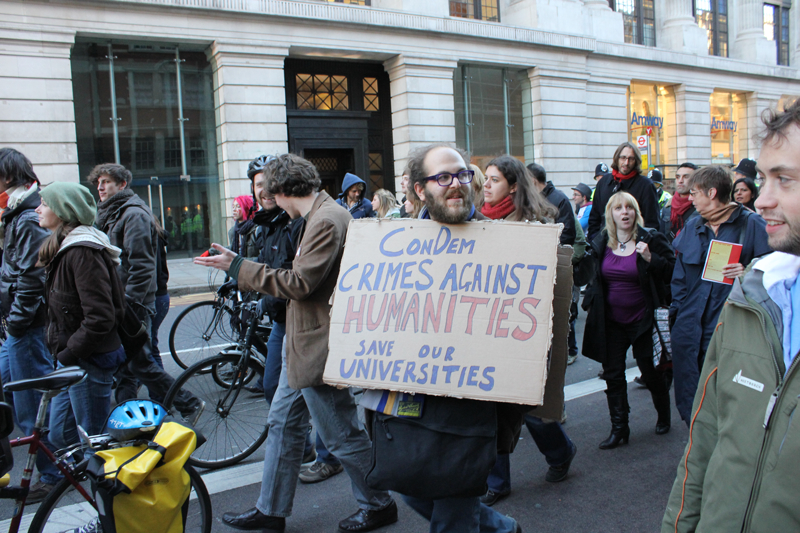
Thousands protest against Government Spending Review

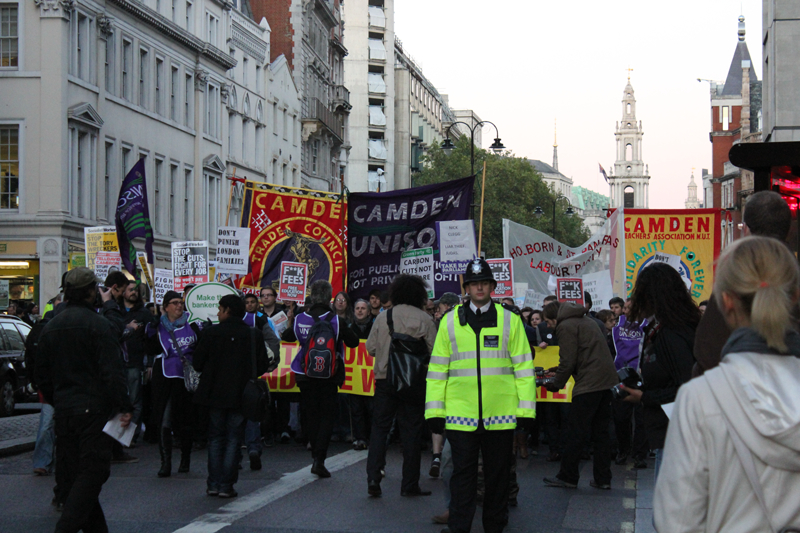
Thousands of students, trade unionists, community groups and others marched through the streets of London in protest following the brutal spending cuts issued by the Tory government yesterday.

Students from University College London and surrounding universities initiated the march on their campus and were soon joined by thousands of others united in the cause. Banners on display reflected the diversity of those protesting, including unions such as Unison, the National Union of Teachers and the GMB. The procession passed through Central London and ended up at a rally outside Downing Street. Simultaneously thousands of demonstrators were also gathered at a rally at Lincoln’s Inn Fields where Tony Benn, as well as other trade union and movement leaders addressed thousands of angered protesters. The Lincoln’s Inn Fields protesters later marched towards Downing Street.

Local protests were also organised around the UK;  a clear indicator of the public’s outrage at the proposed rebudgeting of the country’s coffers.

To read related articles go to our blog and to IndyMedia.

Spectacle homepage
Befriend Spectacle.Docs on Facebook
Follow SpectacleMedia on Twitter

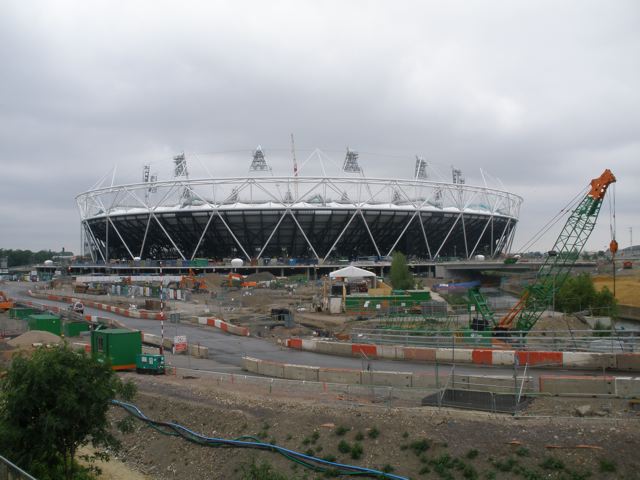
Spurs bid for Olympic 2012 stadium without track

Spurs challenge how much the Olympic Legacy Company really want an athletics track.

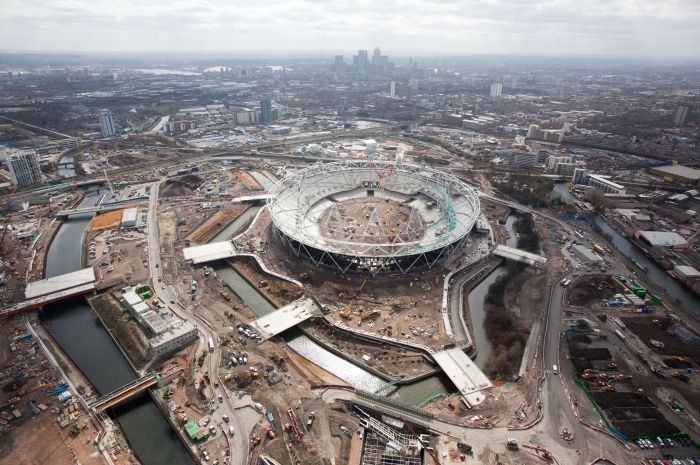
Spurs, in conjunction with entertainment giant AEG, made a shock move last week to take over the stadium after the 2012 London Olympics. But the club do not want a track running around the outside of the pitch, a clause which could seriously hinder their attempt to move into the venue. Or will it?

Timothy Leiweke , chief executive of the club, claimed the Olympic Legacy company would be likely not to accept their bid in light of these circumstances. “I think it is a crime if you sacrifice having a perfect football stadium for convincing yourself you are going to do a track and field event every 10 years,” Leiweke was quoted as saying in the London Evening Standard.

AEG Europe chief executive David Campbell believes the athletics track is not a deal breaker. He claimed that any expressions of interest in the stadium which would decide the venue’s future, did not oblige bidders to retain the running track.

Will the promised Olympic “legacy” of an athletics track trump the money on offer? Will West Ham United regret promising to keep the track in their bid if Spurs win? Will the famous West Ham atmosphere survive the dead space of the track or will it become another loss in the litany of negative Olympic impacts on East London?

For full article see here.

Click London Olympics for more blogs
See our Olympics project pages for more information and videos.
Or visit PlanA our general blog on urbanism, planning and architecture.

Spectacle homepage
Befriend Spectacle.Docs on Facebook
Follow SpectacleMedia on Twitter
London 2012 Olympics saved from cuts in Comprehensive Spending Review

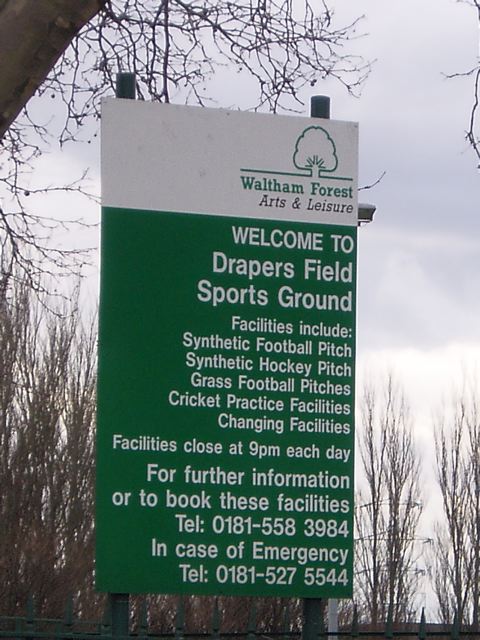
Drapers Fields trashed for an Olympic depot

Grass roots sports lose- Olympics win

Schools and community sports will be the biggest losers under the Comprehensive Spending Review while the London Olympic project is likely to avoid major cuts to its budget or contingency. Losses of local sports amenities like Hackney Marshes and Drapers Fields as a result of the Olympics will now roll out across the nation as non-Olympic cuts hit.

The Department of Culture, Media and Sport is understood to have reached a settlement with the Treasury that will see about 30 per cent cut from its annual £1.6 billion budget. However London 2012 will  escape significant cuts to its £9.3 billion budget, and is expected to have its remaining contingency fund left largely untouched, partly out of necessity and partly expediency.

It is claimed that most of the major Olympic contracts have been awarded, so it is too late for major savings. The games are predicted to be completed with surplus contingency of £700 million. However the DCMS and the Olympic bodies have argued that is politically better to leave the contingency in place rather than take it back, and risk having to pay out in the event of an unforeseen crisis in the project.

The cuts to the DCMS budget will make it unlikely that the government can deliver on its promise of an abiding participation legacy from the London 2012 Olympics.
Sports minister Hugh Robertson will prioritise protecting funding for elite athletes in the run up to the London Games, and grass roots initiatives and projects run by UK Sport and Sport England’s will be cut.
Shadow Olympics Minister Tessa Jowell who told the nation the Olympics would only cost £3bn when it was nearer £10bn now claims she is concerned school sports initiatives will be hit by the cuts. So clearly nothing to do with her.

The details of the Olympic funding will not be announced by the Government on Wednesday. The cuts are likely to be made public on Thursday.

Click London Olympics for more blogs
See our Olympics project pages for more information and videos.
Or visit PlanA our general blog on urbanism, planning and architecture.

Spectacle homepage
Befriend Spectacle.Docs on Facebook
Follow SpectacleMedia on Twitter
Glastonbury Cancelled Due To London Olympics

Glastonbury 2012 has been cancelled due to the London Olympics procuring all available portable toilets in the south of England. In addition, the organisers have also been told that all the 600 strong police force which patrols the event will also be redirected to patrol the Olympics.

Michael Eavis spoke of a price hike in 2012 for any spare toilets due to their scarcity, which would also inevitably lead to problems. “I can see it getting very expensive,” he said. “So we looked at the timing and thought that a year off seemed sensible.”

Sadly, yet somewhat unsurprisingly, the Glastonbury Festival has become another casualty of the ever increasing collateral damage inflicted by the controversial 2012 Olympic event.

For the full article see Live4Ever.

Click London Olympics for more blogs
See our Olympics project pages for more information and videos.
Or visit PlanA our general blog on urbanism, planning and architecture.

Spectacle homepage
Befriend Spectacle.Docs on Facebook
Follow SpectacleMedia on Twitter

50,000 promised Olympic Jobs becomes 70,000 unpaid McVolunteers

No Jobs only McVolunteers

No Jobs only McVolunteers

Countless employers are now facing the problem of dealing with twenty three working days without key employees come 2012.  The deadline to volunteer for the Olympics is the 27th of October, 2010. The London 2012 Olympics Organising Committee (LOCOG) have stated that 70,000 voluntary positions need to be filled, but more than 100,000  people have already applied. The voluntary roles consist of general and specialised positions, from desk staff, events stewards and drivers. Volunteers must work for a minimum of 10 days for the Games, and 20 for the Paralympic Games. Training is also mandatory for all participants.

There are also a further 8000 positions to be filled for the role of “London Ambassadors”, which would involve helping the vastly overstated and questionable increase of tourists and visitors in 2012 find their way around the city.

For more information visit.

These voluntary positions have been the source of much controversy. Back in 2007 London’s Employment and Skills Taskforce and the London Development Agency (LDA) were talking of the Olympics creating up to 50,000 new jobs in the Lower Lea Valley. Dee Doocey, chair of the Committee for Economic Development, Culture, Sport, and Tourism, the leading committee on the London Assembly for scrutinising the Olympics, commented on the announcement of a new ‘Living Wage’ for London of £7.20 an hour:

“The Mayor and Seb Coe signed an ‘Ethical contract’ with London Citizens before winning the Olympics, promising a Living Wage for everyone involved. Yet to date, no Living Wage has been included in the contracts allocated and Seb Coe told the London Assembly that ‘any of the issues about a living wage is a consideration, not a condition’. This is of great concern because LOCOG will be letting contracts for all the traditionally low paid jobs such as catering and cleaning. As for local businesses exploiting the games, as Coe had suggested, it is more likely that existing businesses will be endangered.”

The “workers” will be given Macdonalds meals and bus travel for the day, but are not even allowed free tickets for the events. To read more on this click here, here, and here.

Click London Olympics for more blogs
See our Olympics project pages for more information and videos.
Or visit PlanA our general blog on urbanism, planning and architecture.

Spectacle homepage
Befriend Spectacle.Docs on Facebook
Follow SpectacleMedia on Twitter
ETOA claims Olympics are bad for tourism

The European Tour Operators Association (ETOA) has warned that the 2012 Olympic games would be harmful to Britain’s tourism industry. The ETOA has published research from cities who previously hosted the Olympic Games, which shows it has a “profoundly disruptive” effect on local tourism. They describe the official estimates for the number of visitors as “exaggerated”. The association warned: “Normal tourist businesses suffer during the Games period . . . The region around the Games can suffer more than the host city . . . The impression that everything will be overcrowded and overpriced blights a region . . . [and] these difficulties are exacerbated by exaggerated claims of the benefits derived from the Games.”

Meanwhile Boris Johnson is drumming up a further 8000 voluntary positions for the role of “London Ambassadors”, which would involve helping the vast increase of tourists and visitors in 2012 to find their way around the city. So no paid tourism jobs there.

They can perhaps help shepherd the 70,000 unpaid volunteers in McDonald’s regalia.

Job anyone?

For more information click here

For more information on 2012 controversy click here

Click London Olympics for more blogs
See our Olympics project pages for more information and videos.
Or visit PlanA our general blog on urbanism, planning and architecture.
Befriend Spectacle.Docs on Facebook
Follow SpectacleMedia on Twitter

The loss of a British Institution looms

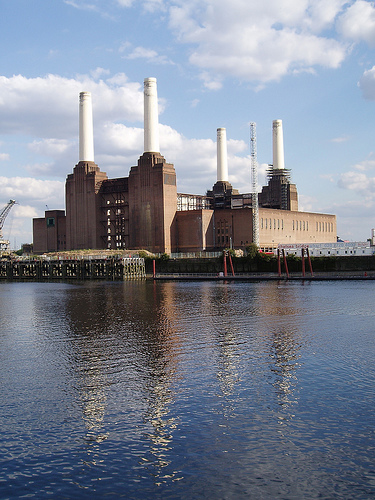
An important symbol of South London and a key feature of the city’s skyline, the Battersea Power Station, has been left to decay for more than twenty years. Created by Gilbert Scott in 1935, the building has slowly rotted away after both station’s A and B were  decommissioned in 1975 and 1983 respectively. The much-loved monument is listed on the English Heritage’s “Buildings at Risk” register.

For full article please click here.

Click Battersea Power Station for more blogs
See our Battersea Power Station project pages for more information and videos.
Or visit PlanA our general blog on urbanism, planning and architecture.

Spectacle homepage
Befriend Spectacle.Docs on Facebook
Follow SpectacleMedia on Twitter

Chief organiser of Commonwealth Games promotes his services

Suresh Kalmadi, chief organiser of Commonwealth Games, has offered up his services to the 2012 Olympics. He claims the games in Delhi have been such an outstanding success that 2012 would greatly benefit from his input. Despite last-minute worries about the unstable construction work of the Athlete’s village, “unfit for human habitation”; Kalmadi argues the event has shown the world that a Third World country is a perfectly capable host.

The Commonwealth Games were intended to showcase India’s economic rise to the world, but it soon became bogged-down in incompetence and infighting. Its defenders have proclaimed that the opening ceremony was enough to silence critics, although some have stated the games have suffered from poor ticket sales and general lack of interest from the public. Kalmadi denies all criticism and insists it has been an unqualified achievement.

For more information on this story click here

Click here for more blogs
See our Olympics project pages for more information and videos.
Or visit PlanA our general blog on urbanism, planning and architecture.

Spectacle homepage
Befriend Spectacle.Docs on Facebook
Follow SpectacleMedia on Twitter

Greater London Industrial Archaeology Society Pump House demolition objection letter

Profiting from demolishing our heritage

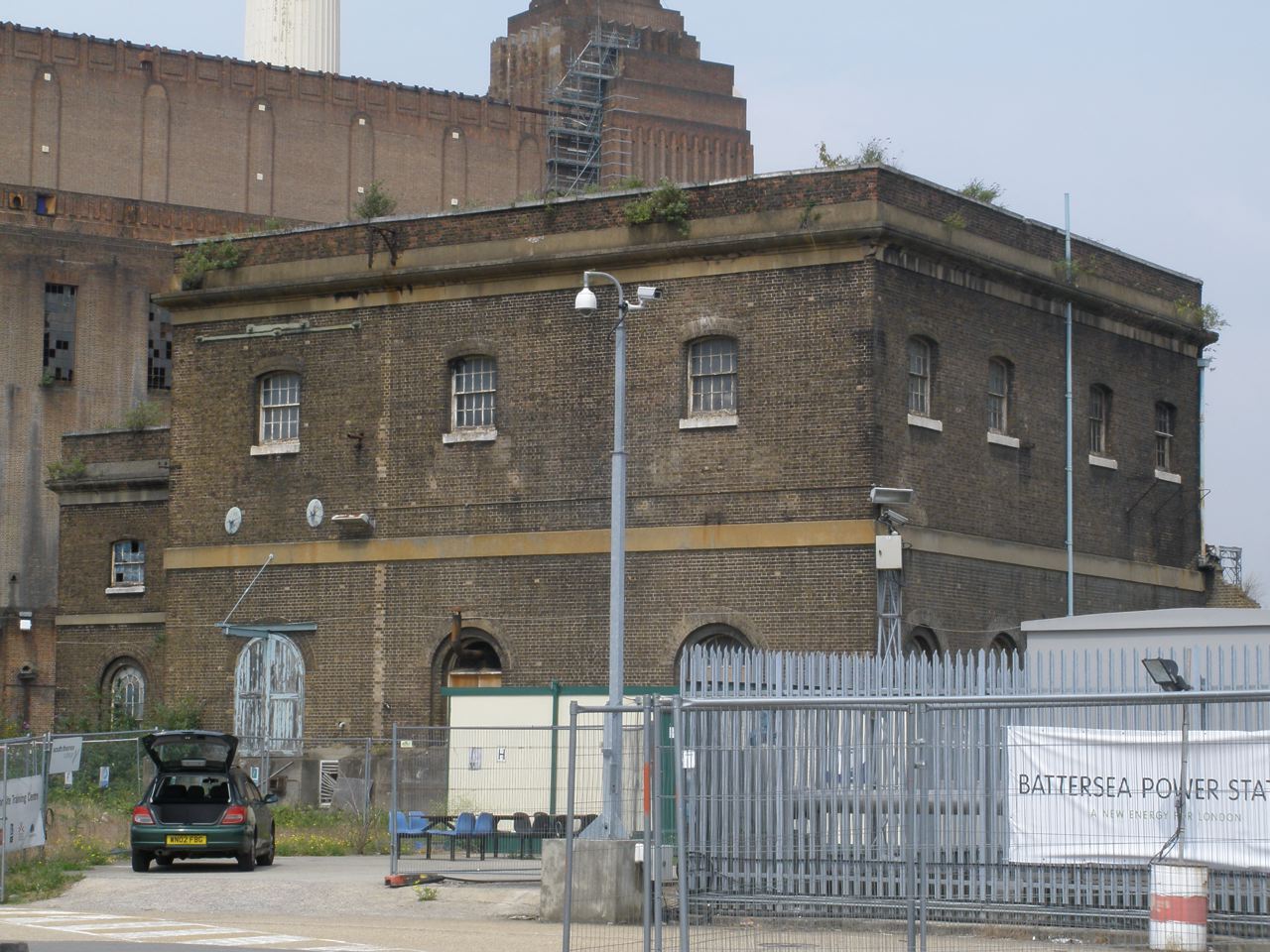
Malcolm Tucker of the Greater London Industrial Archaeology Society has written a letter objecting to the demolition of the grade II listed Victorian Pump House situated next to the Battersea Power Station.

The letter is both a detailed inventory of the archaeological and cultural value of the site that “developer” REO/Treasury Holdings want to raze to the ground in the name of making more money, and a demolition of the arguments for demolition in the recently circulated Planning Policy Statement 5 Assessment, prepared by Donald Insall Associates Ltd and dated September 2010.

Matthew Tucker observes that:

….their arguments for demolition of the building centre on PPS5 Policy HE9.2, and on the wording of listing description and the stated conclusion of the CgMs report that the building has ‘limited architectural, artistic or archaeological significance’. We believe that the building does have architectural and archaeological significance and that its demolition would deny future generations an appreciation of the transition of the Cornish engine from mine pump to waterworks engine. Further, we point out below that it should be possible to incorporate the conserved building within the scheme.

We may add that since CgMs prepared their Historic Building Record in 2005, the original drawings and other records of the building have been studied in detail by Colin Thom of English Heritage Survey of London, corroborating and expanding upon this society’s own researches.

The letter outlines 5 main points:

1) Function and fabric as contributors to the significance of the building.
2) Assessment of architectural significance
3) Significance of artefacts
4) Structural condition
5) Accommodating the building within the development

If you would like to read the  letter in full you can download it here:

If you would like to add your voice to the objections write to: Bob Leuty BLeuty@wandsworth.gov.uk

Please also send spectacle a copy info@spectacle.co.uk so we can be sure your objection is circulated.

Click Battersea Power Station for more blogs
See our Battersea Power Station project pages for more information and videos.
Or visit PlanA our general blog on urbanism, planning and architecture.

Spectacle homepage
Befriend Spectacle.Docs on Facebook
Follow SpectacleMedia on Twitter