
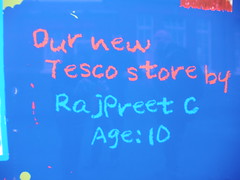
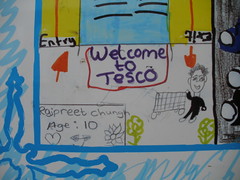
Bordon – The Next Tesco Town?


In a recent interview with Jack Warshaw, a local resident to the Bordon area and member of the Bordon Area Action Group (BAAG) committee, the suggestion that the Eco-Town development could lead to the decline of Bordon from a small and quaint town to becoming one of the many new emerging ‘Tesco Town‘ arose.

I hear you all now, what is a ‘Tesco Town’? We all, whether we like it or not have some association with this vast supermarket chain; whether it be the place you do your weekly food shop, your mobile phone provider or where you go for travel insurance – let’s face it, Tesco are taking over the world, well the UK at least.

But what does this mean for other businesses? It cannot have gone unnoticed that over the last few years, independent petrol stations have slowly been disintegrating and being replaced with Tesco, Sainsburys or Morrisons petrol stations, your good old corner shops which used to stock weird and wonderful products are now Tesco Express or Coop Local and fashion magazines are now filled with the latest bargains from George at Asda or Cherokee at Tesco.

This new supermarket craze is helping the rich get richer and the poor get poorer. Tesco controls over 30% of the grocery market and certainly does not seem to be suffering the recession blues.

The problem. Towns and villages are losing their charm, for each new Tesco store that opens up, a small part of that town vanishes being replaced by a  superstore with no local history. The days when shoppers knew which family owned which business and each store had a purpose are slowly disappearing as everything you could possibly ever need can now be found under one roof or online.

Jack states, ‘Tesco would be delighted if there was an Eco Town here because they would instantly try to expand to be even bigger… once again you’re looking at a clone town, a Tesco town, an anywhere town, the type of place where all the potential for individual character is eroded and lost’

You don’t need to look far for examples of Tesco towns, towns where the high street is dominated by chain stores and pleasant pedestrianized streets have been turned into car parks – there is even an online society concerned with the power these supermarkets have over the consumer market. This is of course not just happening here, the US are dominated with the giant supermarket chain Walmart and that too, is slowly taking over.

One thing is for sure; there are plenty of people unhappy with this supermarket domination and Bordon residents are no exception. Eco town or no eco town, surely the voice of the locals should be considered before turning what was a small and delightful town into a large and generic housing area.

To see interviews with Bordon Councillors, residents and Bordon Area Action Group members see our Eco Towns and Villages project page or our read the latest blog here.

Or visit PlanA our general blog on urbanism, planning and architecture.

Spectacle homepage
Befriend Spectacle.Docs on Facebook
Follow SpectacleMedia on Twitter
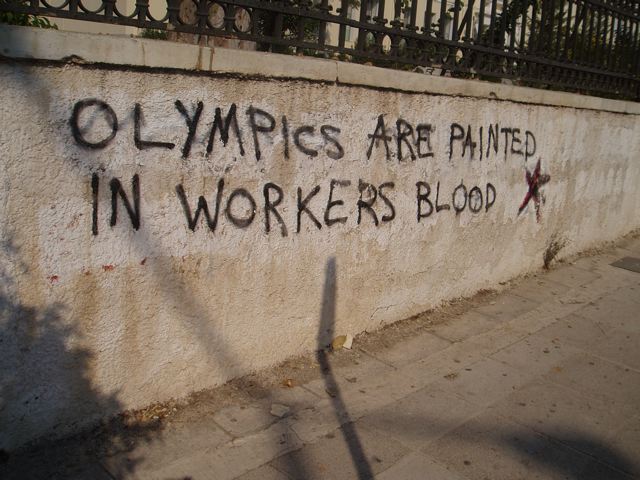
Hold Olympics 2012 in Athens

Grafitti Athens 2004

Graffiti Athens 2004

The Greek government spent €25 billion on the Olympics. The austerity package they are undergoing will save €30 billion. Their plight therefore seems to be an Olympic Legacy effect. They also have expensive unwanted sports facilities rotting away unused.

The just as debt laden UK government proposes to find £6 billion in cuts in the coming year. The London Olympic 2012 project is costing £9 billion and rising.

I would therefore suggest that the Olympics 2012 are held in Athens and the London project is stopped before they vandalise Greenwich park and rip up the Hackney Marshes. This would allow the Greeks to get some use out of their sports facilities and perhaps earn some money to pay off  some of their debts. Recycling the buildings would also make it a greener low impact Olympics.

By the way the London 2012 organisers have not got insurance to cover the loss of revenue if the Icelandic volcano erupts and disrupts flights. Would you bet against it NOT erupting during the games?

Click London Olympics for more blogs
Or visit PlanA our general blog on urbanism, planning and architecture.
See our Olympics project pages for more information and videos.

Spectacle  homepage
Befriend Spectacle.Docs on Facebook
Follow SpectacleMedia on Twitter
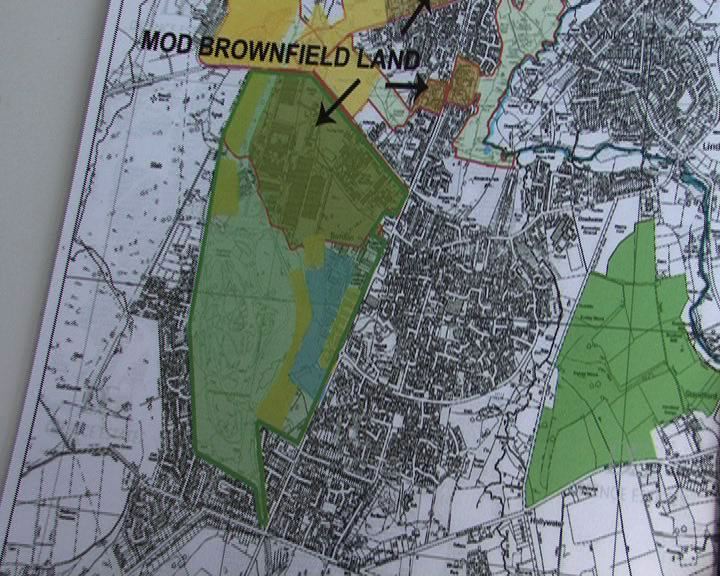
Eco Town? Everyone is doing it…

Malmö in Sweden, Freiburg in Germany and Amersfoort in Holland, they’re all doing it – Eco Town’s appear to be the next big thing and the UK is not far behind. With potential eco projects already planned in Cornwall, Oxfordshire and Norfolk,  Spectacle have now turned their focus closer to home and onto the small town of Bordon in East Hampshire.

The town is looking to go through an enormous makeover with 5000 new homes built to the Government’s criteria on ‘Eco-towns‘ resulting in a vast amount of funding to aid the development of the Council’s Master plan.

The catch. The town’s population will double in size, the new homes may interfere with green spaces and wildlife, the development is proposed over 20 years and Bordon seems unlikely to be able to cope with the increase of people due to the lack of infrastructure and facilities already present.

It would seem Bordon residents are content with their small town status and although happy to foresee some improvements and increases in housing, the proposed 5000 new homes has generated  controversy.

Residents were generally satisfied with the initial plans of 2000 homes but the new plan of 5000 has triggered the locals to speak up and appeal this huge proposal for the area.

The Bordon Area Action Group (BAAG) has been formed to protest the plans and has attracted a lot of local interest. Spectacle visited the area on the 24th of April and interviewed several of the groups members and supporters as well as one of East Hampshire’s Council members and the interviews can now be found online on the Spectacle project page.

It seems the question everyone wants to know the answer to is what makes this new development Eco? Is this really an effective answer to going green or simply an excuse to solve wider issues such as housing and funding?

Click Eco Towns and Villages for more blogs
Or visit PlanA our general blog on urbanism, planning and architecture.
See our Eco Towns and Villages project pages for more information and videos.

Spectacle homepage
Befriend Spectacle.Docs on Facebook
Follow SpectacleMedia on Twitter
Scant evidence for destruction of Battersea Pumping Station

The future of Battersea Pumping Station, located next to the Battersea Power Station, is in serious doubt. If the current planning application to redevelop Battersea Power Station and the surrounding land by REO / Treasury Holdings is accepted without alteration by Wandsworth Council in July, the Grade II listed building would be demolished under assertions by the developers that the scheme would not be economically viable with its continued existence.

However, evidence to support this claim is less than accurate. Neither in the private nor public domain have the developers or Wandsworth Council revealed the percentage split of affordable and luxury housing. Without knowing what percentage of the planned housing developments will be “luxury” or affordable apartments it is not possible for REO, let alone English Heritage, to know how much profit the developers will make, therefore arguments over the economic viability of the scheme are spurious. Assuming the developer calculated the minimum amount of “affordable” flats would be needed the issue is not the economic viability of the scheme but the size of REO/Treasury Holdings profit margin.

REO argue that the Pumping Station should be demolished for the “Community benefit” but what they mean is their profit. It is becoming depressingly common for developers to present their economic interests as a community benefit. In this case what is actually meant is that if the developer does not get its way and make a substantial profit then the scheme will not go ahead and the community will suffer decades more planning blight.

Despite formally submitting their application in November 2009 in which they declared that flattening the pumping station would be critical, in February the only definitive number of houses of the 3856 dwellings of the master plan given any ‘status’ whatsoever are the 245 build-to-let houses – classified as non-affordable. As recent as March this year, in a Q & A session with the Planning Director Jeremy Castle, the percentage of affordable housing against non-affordable had still yet to be decided.

English Heritage, an organisation whose official remit is to promote and protect Britain’s historical environment, have effectively given their blessing to REO by deferring any decision-making responsibility to the Local Planning Authority.

In a letter to the Local Planning Authority, Nick Collins stated that although the proposed plans “risk causing harm to the setting”, the decision ultimately rests on assessing whether or not the ‘substantial community benefit’ (community benefit in this case being  private gain) outweighs the loss of the building and whether or not the building could be bought up by another party and reused (you can see the new legislation PPS5 here).

Under this new legislation the council must establish no other organisations are interested in buying the building or that no alternative community use can be found. Battersea Power Station Community Group has registered its interest and is supported by  a number of  local and special interest groups.

The Victorian Society is one of a number of expert groups who are against demolishing  the Pumping Station, yet they have been ignored (see the interview with Alex Baldwin from The Victorian Society here).

Jeremy Castle plans to reveal the official percentage of affordable housing on June 15th – less than a month before Wandsworth Council make their final decision on the application. Aside from the absurdity of demanding a 150 year-old building be torn down because ‘it might be handy’, the relinquishing of accountability by organisations like English Heritage  demonstrates an alarming and depressing deference to private business when they are funded to enforce and support preservation.

The exhausting planning process and massive application documentation helps developers like REO / Treasury Holdings to wear down any resistance and bury the fact that they intend to destroy historically and culturally significant sites without open discussion. As English Heritage have in recent years funded the restoration of Cross Ness Pumping Station, their dereliction of duty and unfounded support for the vandalism of Battersea Pumping Station is curious.

Click Battersea Power Station for more blogs
Or visit PlanA our general blog on urbanism, planning and architecture.
See our Battersea Power Station project pages for more information and videos.

Spectacle homepage
Befriend Spectacle.Docs on Facebook
Follow SpectacleMedia on Twitter
Commissioning Poverty and Creative Authorship

Poverty in the Media – Commissioning Priorities

Poverty is a problem faced by both individuals and society.

Societies commentators are an exclusive group, selected via a hierarchy and instated within a system, how representative can their voice be of the individuals who, because of the restrictions of their experience, do not rise through this?

The stories that find there way into the mass media produce a profound impact on the public subconscious; all mediated by the editorial chain, with whom the conditions are set and must be met to be accepted. The commissioning editors of both BBC and Channel 4 documentaries present similar priorities in their commissioning guidelines: Their requests come in loaded language – requesting proposals to match.

Hamish Mykura, Head of Documentaries for More 4 lists ‘harrowing’ ‘obsessed’ ‘extreme’ and ‘compelling’ in the descriptions for previous successes, the titles of which are equally charged (Eight Minutes to Disaster, Killer in a Small Town).
Alternatively, there is a focus on the ‘cheeky’ (BBC3) or the BBC4 equivalent ‘witty’, with both seeking ‘onscreen talent’ just as Channel 4 emphasises ‘presenter-led’ documentaries; encouraging programmes that are less focused on informative or critical worth and more (as requested by BBC3) the ‘entertainment values in their DNA’.

None of these criteria are detrimental in themselves but with this blanket approach to issue based programming, there is an obvious conflict of interests, the end point of which is arrived upon by Mark Raphael.

“I want to make ‘Risk Taking’ films that shed light on subjects we thought we already knew. ‘Provocative’ films that stir controversy, and ‘Popular’ films that thrill and excite large audiences.”

Mass appeal and commercial viability, are not criteria that encourage varied and responsible reporting. Industry checks may happen but if the material never leaves this sphere, pre-public release, there can be no dialogue. Fact checking, largely to avoid any potential legal repercussion, only happens to concrete information, not implication and is far more perceptible in specific rather than abstract cases. Where backlash does happen, it tends to pass more quietly than the impact of the broadcast programme.

When RDF went head to head with the Queen (A Year with the Queen, BBC, 2007) the BBC placed all blame with RDF, whose misleading editing meant producer, Stephen Lambert’s, head rolled. Now he’s back (as Studio Lambert) with Benefit Busters and RDF are free to continue with programmes, Wife Swap and The Secret Millionaire. It is not the representation, but the victim and resource with which they can respond, that affects the reaction – but the personal harm and perceptual effect is no less dramatic for those without recourse.

The power the media wields in propagating and reinforcing hegemonic ideals has long been recognised: The veil of entertainment and pretext that responding to audience choice, removes the onus from the media, only highlights the need for institutional change.

This is just one of the issues that Spectacle’s ‘Poverty and Participation in the Media’ project seeks to address; finding alternatives, opening up discussion and challenging what is seen to be the authoritative voice. The project was commissioned as part of the Joseph Rowntree Foundation’s ‘Public Interest in Poverty Issues’ campaign, and project content can be viewed online at:
www.spectacle.co.uk/poverty-and-the-media

Sufficient affordable housing in Battersea Power Station plans?

The comments below are from Chelsea Bridge Wharf resident Mike O’Driscoll, who is one of a  significant number of residents to have lodged formal objections against the Battersea Power Station plans.

The issues mentioned in your post concerning formal objections by residents of Chelsea Bridge Wharf to the current development plans for Battersea Power Station are worrying for residents but what is more worrying for the area, and for London as a whole, is that Wandsworth Council and the developers are clearly trying to fudge the issue of how much affordable housing would be included in the development. When so many people cannot afford a home it would be obscene for this development to go ahead without insisting on 50% of homes being affordable.

The Council is however refusing to say how many affordable homes would be included and claims that it is unable to say how many there would be because it is not clear what the demand is! I suggest you write to Mr Bob Leuty at Wandsworth Council (planningapplications@wandsworth.gov.uk) and make it clear that you do not support any development unless it includes 50% affordable housing. You can also contact your Wandsworth Councillor, or your local MP, and ask them what their view is on this before deciding how to vote.

If we allow this development to continue without clarification on the issue of affordable housing then we are simply allowing the developers to make themselves even richer and making this area even less diverse socially.

Click Battersea Power Station for more blogs
Or visit PlanA our general blog on urbanism, planning and architecture.
See our Battersea Power Station project pages for more information and videos.

Spectacle homepage
Befriend Spectacle.Docs on Facebook
Follow SpectacleMedia on Twitter
The Victorian Society Object to Power Station Plans

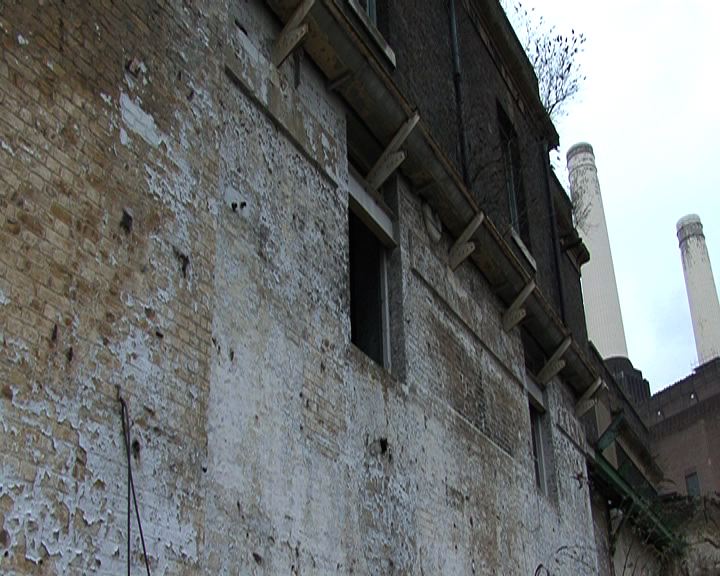
The Victorian Society are the latest organisation to speak out against REO / Treasury Holdings‘ current plans for the re-development of Battersea Power Station. The Conservation Advisor of the organisation, Alex Baldwin, spoke in depth to Spectacle about their rejection of the assertion that the older structures, particularly the old pumping station, need to be pulled down despite their Grade II* Listed status, and her ideas on how the site could be regenerated. You can watch the interview here at Spectacle’s Battersea archive.

Alex also contributed her thoughts to a Planning Resource webzine article about the mixed response to the situation. Her comments are the latest in a growing number of objections to the plans (about which you can also see a presentation by REO here), and evidence that there is likely to be considerable formal resistance to the application.

Click Battersea Power Station for more blogs
Or visit PlanA our general blog on urbanism, planning and architecture.
See our Battersea Power Station project pages for more information and videos.

Spectacle homepage
Befriend Spectacle.Docs on Facebook
Follow SpectacleMedia on Twitter
Silwood Community Forum – Wednesday 5th May – NEW SPEAKER

P4040153.JPG

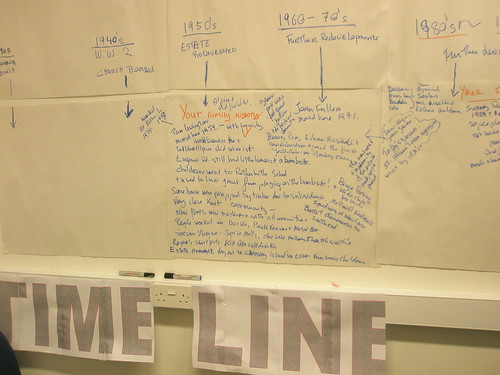
John Lumley, the Development Manager for the Silwood project, has agreed to attend next week’s Residents’ Community Forum and will be available to answer any questions. The meeting will take place at 6:30pm at the Lewington Centre.

Click Silwood Video Group for more blogs
Or visit PlanA our general blog on urbanism, planning and architecture.
See our Silwood Video Group project pages for more information and videos.

Spectacle homepage
Befriend Spectacle.Docs on Facebook
Follow SpectacleMedia on Twitter
The Good. The Bad. And Section 106.

Sil Workshop 28-07-05

Spectacle, having established the Silwood Video Group, have been an active presence on the Silwood Estate since 2001, and in nearly 10 years of voluntary film-workshops and attendance at Residents’ Meetings, we have seen the landscape of this slice of South-East London change, and change as a result of regeneration.

Since 2005 at the Residents’ Forum Meetings, which are now held quarterly, the residents have asked to see the business plans for development and to have access to details of Section 106, which was declared a ‘non-public document’ by the London & Quadrant NIT Manager on the Silwood. The statement was later retracted, but the Section 106 document, to date, has not been made available to residents.

Tower Homes, the commercial wing of London & Quadrant, won the planning permission rights to the land in the Silwood area, on which they intended to build luxury apartments. By law, this makes them accountable to Section 106 Agreement of the Town and Country Planning Act (1990), which states that if development is agreed upon, for example, Lewisham Council awarding planning permission to Tower Homes, then the new landowners must provide resources that are of benefit to the community that will be affected by the development. In the case of the Silwood, London & Quadrant was entrusted with the responsibility of overseeing the re-provision of community facilities, play areas/ parks, and youth centres on the Estate, which were demolished as a result of the regeneration process. The Lewington Centre was then built as a replacement for the former community centre and the Cyber Centre under Section 106.

Residents are currently being asked to pay relatively steep rates in order to use their new Centre, but the bone of contention lies in the fact that, according to the ‘Regeneration Project Initiation Document’, freely available from Lewisham Council, London & Quadrant allocated a fund of £2 million in order to meet their Section 106 obligations. On top of this, despite the claim of London & Quadrant representatives at Residents’ Meetings on the Silwood that these rates are essential to their business plan and the long-term running of the Lewington Centre, their business plan for 2009 shows that they have made a profit in the region of £120, 000. So why do they seem so unwilling to invest in fully rebuilding the local infrastructure?

Click Silwood Video Group for more blogs
Or visit PlanA our general blog on urbanism, planning and architecture.
See our Silwood Video Group project pages for more information and videos.

Spectacle homepage
Befriend Spectacle.Docs on Facebook
Follow SpectacleMedia on Twitter
Silwood Land for Silwood Residents?

Sil 180707

As part of the continued regeneration of the Silwood Estate, an application has been submitted by London & Quadrant Housing Association for planning permission on vacant land that residents wanted to be used to provide play areas for their children. After a series of quarterly meetings in which residents were unable to obtain information from L & Q representatives as to status of the Lewisham Council-owned land, it has become apparent that the housing trust themselves have made a bid for it. According to Planning Application DC/09/73169/X , L & Q are seeking permission to build tower blocks ‘ranging from 2 storeys… to 6 storeys’ in the area north of Silwood Street. Residents have requested that this issue be raised at the next Silwood Community Meeting.

Click Silwood Video Group for more blogs
Or visit PlanA our general blog on urbanism, planning and architecture.
See our Silwood Video Group project pages for more information and videos.

Spectacle homepage
Befriend Spectacle.Docs on Facebook
Follow SpectacleMedia on Twitter